
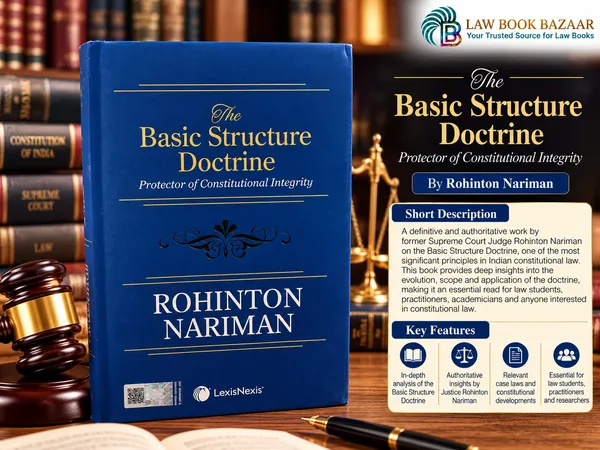

Nariman's The Basic Structure Doctrine Protector of Constitutional Integrit..More
₹920
₹970
5% OffFinal Price inclusive of all taxes
Civil Law and Constitution : Multi


Cash on Delivery
Get it delivered in 3-7 days
size
Free Size
Product Information
Binding Type
Hardbound
Language
English
ISBN
9789349015661
Publication
LexisNexis
Material
Paper
Pack Of
1
Ideal For
� Supreme Court Advocates � High Court Advocates � Constitutional Law Practitioners � Judges and Judicial Officers � Senior Advocates and Legal Consultants � Constitutional Law Researchers � Law Professors and Academicians � LL.B. and LL.M. Students � Judicial Services Examination Aspirants � Legal Scholars and Policy Researchers � University and Institutional Law Libraries � Researchers Studying Indian Constitutional History
COO
India
Pages
406
Product Description
The Basic Structure Doctrine � Protector of Constitutional Integrity by Rohinton Nariman, published by LexisNexis, is an authoritative legal work exploring one of the most significant principles of Indian constitutional law: the Basic Structure Doctrine.
The book examines the constitutional philosophy and legal principles underlying the doctrine, which safeguards the essential features of the Indian Constitution against amendments that would destroy or fundamentally alter its basic structure.
The Basic Structure Doctrine, established by the Supreme Court of India in the landmark Kesavananda Bharati v. State of Kerala (1973) judgment, remains a cornerstone of Indian constitutional jurisprudence. It places substantive limitations on Parliament's constitutional amending power under Article 368.
This work is particularly relevant to understanding the relationship between constitutional supremacy, parliamentary powers, judicial review, fundamental rights, democracy, secularism, federalism, separation of powers, and the rule of law.
Written by distinguished jurist and former Supreme Court Judge Justice Rohinton Fali Nariman, the book offers an important perspective on constitutional interpretation and the continuing significance of the Basic Structure Doctrine in protecting India's constitutional identity.
It is a valuable reference for Supreme Court and High Court advocates, constitutional law practitioners, judges, legal scholars, researchers, academicians, and law students seeking a deeper understanding of Indian constitutional principles.
KEY FEATURES OF THE BOOK
� Authoritative Constitutional Perspective: Written by former Supreme Court Judge Justice Rohinton Nariman.
� Focus on the Basic Structure Doctrine: Explores the doctrine's significance in safeguarding the Indian Constitution.
� Constitutional Amendment Powers: Relevant to the scope and limitations of Parliament's power under Article 368.
� Judicial Review: Examines the constitutional importance of judicial oversight and constitutional limitations.
� Fundamental Constitutional Principles: Addresses the importance of democracy, constitutional supremacy, secularism, federalism, and the rule of law.
� Landmark Constitutional Jurisprudence: Relevant to major Supreme Court decisions concerning constitutional amendments and the Basic Structure Doctrine.
� Constitutional Interpretation: Useful for understanding the evolving interpretation of constitutional provisions.
� Professional Legal Reference: Suitable for constitutional law practitioners, judicial officers, legal researchers, and academic institutions.
CORE SUBJECTS
1. Basic Structure Doctrine of the Indian Constitution
� Meaning and Concept of the Basic Structure Doctrine
� Origin and Evolution of the Doctrine
� Constitutional Identity and Integrity
� Essential Features of the Constitution
� Protection of Fundamental Constitutional Principles
2. Constitutional Amendments and Article 368
� Parliament's Power to Amend the Constitution
� Scope and Limitations of Article 368
� Constitutional Amendment Procedures
� Judicial Review of Constitutional Amendments
� Limitations on Parliamentary Amending Powers
3. Landmark Supreme Court Judgments
� Shankari Prasad v. Union of India (1951)
� Sajjan Singh v. State of Rajasthan (1965)
� I.C. Golaknath v. State of Punjab (1967)
� Kesavananda Bharati v. State of Kerala (1973)
� Indira Nehru Gandhi v. Raj Narain (1975)
� Minerva Mills Ltd. v. Union of India (1980)
� Waman Rao v. Union of India (1981)
� I.R. Coelho v. State of Tamil Nadu (2007)
4. Constitutional Supremacy and Rule of Law
� Supremacy of the Indian Constitution
� Rule of Law
� Constitutional Governance
� Limitations on Governmental Powers
� Constitutional Accountability
� Protection Against Arbitrary State Action
5. Judicial Review and Independence of Judiciary
� Judicial Review as a Basic Feature
� Independence of the Judiciary
� Role of the Supreme Court
� Constitutional Interpretation
� Judicial Protection of Constitutional Values
� Separation of Powers
6. Fundamental Rights and Constitutional Protection
� Fundamental Rights under Part III
� Equality Before Law
� Freedom and Liberty
� Constitutional Remedies
� Relationship Between Fundamental Rights and Constitutional Amendments
� Balance Between Individual Rights and State Powers
7. Democracy, Secularism and Federalism
� Democratic Form of Government
� Parliamentary Democracy
� Secular Character of the Constitution
� Federal Structure of India
� Unity and Integrity of the Nation
� Free and Fair Elections
8. Separation of Powers
� Powers of the Legislature
� Executive Authority
� Judicial Independence
� Checks and Balances
� Constitutional Limitations on State Institutions
9. Parliamentary Sovereignty and Constitutional Limitations
� Parliament and Constitutional Supremacy
� Constitutional Restrictions on Legislative Powers
� Relationship Between Parliament and Judiciary
� Constitutional Amendment Disputes
� Protection of the Constitution's Essential Features
10. Evolution of Indian Constitutional Jurisprudence
� Historical Development of Constitutional Interpretation
� Judicial Development of the Basic Structure Doctrine
� Constitutional Morality
� Constitutional Continuity and Change
� Contemporary Relevance of the Doctrine
� Protection of Constitutional Integrity
THIS BOOK IS IDEAL FOR
� Supreme Court Advocates
� High Court Advocates
� Constitutional Law Practitioners
� Judges and Judicial Officers
� Senior Advocates and Legal Consultants
� Constitutional Law Researchers
� Law Professors and Academicians
� LL.B. and LL.M. Students
� Judicial Services Examination Aspirants
� Legal Scholars and Policy Researchers
� University and Institutional Law Libraries
� Researchers Studying Indian Constitutional History