
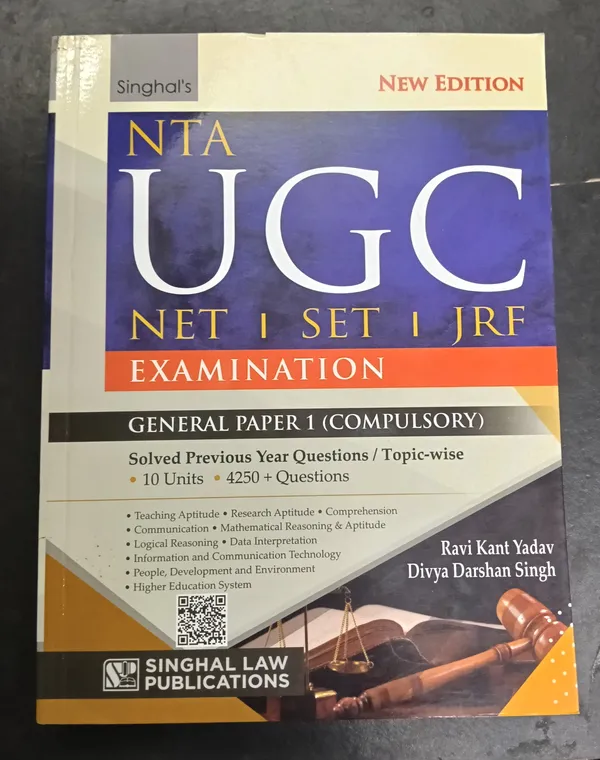
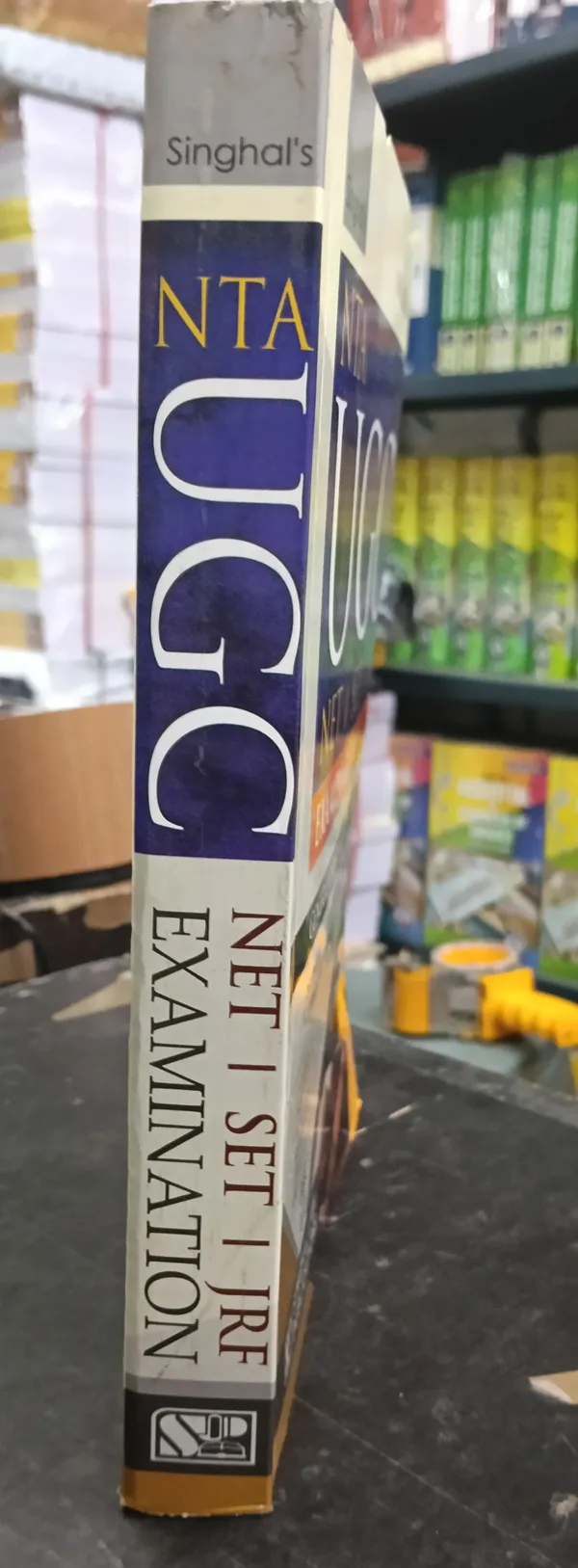

Singhal?? NTA ??UGC NET1 Set 1 JRF Examination
₹565
₹625
9% OffFinal Price inclusive of all taxes
Books for Examinations : Multi


Cash on Delivery
Get it delivered in 3-7 days
size
Free Size
Product Information
Pack Of
1
Pages
564
Material
Paper
Country Of Origin
India
Product Description
"Singhal's NTA UGC NET / SET / JRF Examination: General Paper 1 (Compulsory)", co-authored by Ravi Kant Yadav and Divya Darshan Singh, and published by Singhal Law Publications (available at Singhal Law Publication). It is a highly specialized reference workbook designed for candidates preparing for the National Eligibility Test (NET), State Eligibility Test (SET), and Junior Research Fellowship (JRF).
The book serves as a comprehensive preparatory question bank containing more than 4,250 multiple-choice questions (MCQs) compiled from previous years' examination papers. It structures these questions topic-wise according to the official National Testing Agency (NTA) syllabus to allow students to evaluate their performance patterns, assess weightage distribution, and practice subject areas incrementally.
The 10 Units Covered in the Book
The volume is neatly segmented into the ten foundational sections that constitute the compulsory teaching and research aptitude paper:
Teaching Aptitude: Concepts, objectives, levels of teaching, learner characteristics, and modern evaluation systems.
Research Aptitude: Methods of research, steps of research, thesis writing, and application of ICT in research.
Comprehension: Passages followed by questions to test analytical and linguistic decoding abilities.
Communication: Types, characteristics, and barriers of effective communication in classroom dynamics.
Mathematical Reasoning & Aptitude: Types of reasoning, number series, letter series, codes, fractions, time, distance, and ratios.
Logical Reasoning: Structuring arguments, deductive/inductive reasoning, Venn diagrams, and classical Indian logic.
Data Interpretation: Quantitative data analysis through bar charts, histograms, pie charts, table charts, and line charts.
Information and Communication Technology (ICT): General abbreviations, internet basics, email, audio/video conferencing, and digital initiatives in higher education.
People, Development and Environment: Human-environment interaction, environmental pollution, climate change, and natural resources.
Higher Education System: Institutions of higher learning in ancient India, evolution of modern research, professional/technical education, and administrative policies.
The book serves as a comprehensive preparatory question bank containing more than 4,250 multiple-choice questions (MCQs) compiled from previous years' examination papers. It structures these questions topic-wise according to the official National Testing Agency (NTA) syllabus to allow students to evaluate their performance patterns, assess weightage distribution, and practice subject areas incrementally.
The 10 Units Covered in the Book
The volume is neatly segmented into the ten foundational sections that constitute the compulsory teaching and research aptitude paper:
Teaching Aptitude: Concepts, objectives, levels of teaching, learner characteristics, and modern evaluation systems.
Research Aptitude: Methods of research, steps of research, thesis writing, and application of ICT in research.
Comprehension: Passages followed by questions to test analytical and linguistic decoding abilities.
Communication: Types, characteristics, and barriers of effective communication in classroom dynamics.
Mathematical Reasoning & Aptitude: Types of reasoning, number series, letter series, codes, fractions, time, distance, and ratios.
Logical Reasoning: Structuring arguments, deductive/inductive reasoning, Venn diagrams, and classical Indian logic.
Data Interpretation: Quantitative data analysis through bar charts, histograms, pie charts, table charts, and line charts.
Information and Communication Technology (ICT): General abbreviations, internet basics, email, audio/video conferencing, and digital initiatives in higher education.
People, Development and Environment: Human-environment interaction, environmental pollution, climate change, and natural resources.
Higher Education System: Institutions of higher learning in ancient India, evolution of modern research, professional/technical education, and administrative policies.